
ONYX COFFEE LAB
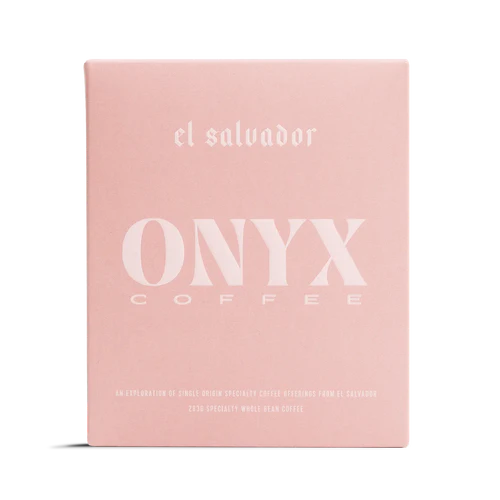
ONYX - Santa Rosa Honey | El Salvador - Red Honey - Pacamara
ONYX - Santa Rosa Honey | El Salvador - Red Honey - Pacamara
 Origin: El Salvador
 Tasting Notes: Red Grape, Rose, Mulberry, Vanilla

 Process: Red Honey
 Varieties: Pacamara
 Roast Profile: Light
 Recommended Brew: Espresso and Filter
 Roast Date:
Couldn't load pickup availability
ONYX Coffee Lab is located in Rogers, United State
From ONYX
Our relationship with Finca Santa Rosa spans more than a decade, with the last eight years shaped by an increasingly collaborative process of selection, feedback, and refinement. Raul’s precision in agronomy, processing, and lot separation allows us to cup and build our purchases from individual day lots, selecting only Pacamara coffees that meet an exceptionally high quality threshold.
The Story
Our relationship with Finca Santa Rosa stretches back more than a decade, with the last eight years shaped by an increasingly close process of selection, feedback, and refinement. The coffees Raul produces are consistently among the strongest lots we taste, but what ultimately reaches our menu is the result of an unusually detailed process of curation between Santa Rosa and Onyx. Raul’s strengths begin on the farm. He is exceptionally focused on agronomy, variety selection, processing, and lot separation, with expectations for quality that are remarkably high. Throughout harvest, Santa Rosa separates coffees into individual day lots according to picking and processing, giving us the ability to evaluate the farm at a level of detail that would be impossible with larger blended lots.
From those separations, we cup through the strongest selections and build our purchases around the coffees that best represent Santa Rosa. Our threshold is intentionally high: we select Pacamara lots scoring 87 points and above, focusing specifically on washed and honey processes. Those individual micro-lots are then combined into two primary selections each year, a honey lot and an Onyx Reserve washed lot. Together, they make up a full 20-foot container that we import directly from the farm. Over years of working this way, the process has become increasingly iterative. Sensory feedback from our selections gives Raul and his team clear indicators of the profiles we are looking for, while their ability to separate and track coffees allows us to continue narrowing in on those qualities harvest after harvest. Raul brings the agronomic precision and production systems; we work alongside Santa Rosa on sensory evaluation and lot construction. By the time one of these coffees reaches our offerings, it has already passed through repeated rounds of separation, tasting, feedback, and selection at origin.
That same focus extends beyond processing. In recent years, Raul has spent considerable energy refining nutrition at Santa Rosa, evaluating the farm’s soil inputs and working with fertilizer partners to better understand exactly what different areas of the farm require. With fertilizer costs rising dramatically, the goal is both economic and agronomic: applying inputs more precisely while continuing to improve the health and productivity of the farm. Raul approaches all of this with an uncommon intensity. His expectations for Santa Rosa are uncompromising, and that focus has translated into both the consistency of the coffees we purchase and the farm’s extraordinary record in competitions like El Salvador’s Cup of Excellence. Awards, however, are less an endpoint than confirmation of a system he continues to refine.
HISTORY OF SANTA ROSA
Finca Santa Rosa began as a forestry project when Jorge Rivera’s father purchased the property and planted walnut, white oak, and other hardwood trees. During El Salvador’s civil war, the Chalatenango region was heavily affected and the family was unable to regularly access the farm. When they returned to Santa Rosa, the established forest created an opportunity to plant coffee beneath the existing canopy.
At the time, establishing coffee within such a diverse shade system was uncommon. Greater shade meant slower growth and potentially lower yields, but it also created a distinctive environment for coffee while preserving much of the forest already growing across the property. Raul studied agriculture in Honduras and later at Louisiana State University before returning to El Salvador and taking over management of the farm. He began refining Santa Rosa’s approach to fermentation, soil fertility, varieties, and farm management, bringing a highly technical and experimental approach to production.
Today, Santa Rosa primarily grows Pacamara alongside a smaller amount of Gesha, with Pacamara forming the foundation of our work together. The farm has earned repeated recognition in El Salvador’s Cup of Excellence, including first-place finishes, building a reputation that extends far beyond Chalatenango. Yet the thing that continues to define Santa Rosa is not any single award or harvest. It is Raul’s relentless attention to the systems behind the coffee, and a relationship that has allowed us to continually refine what Santa Rosa can taste like.