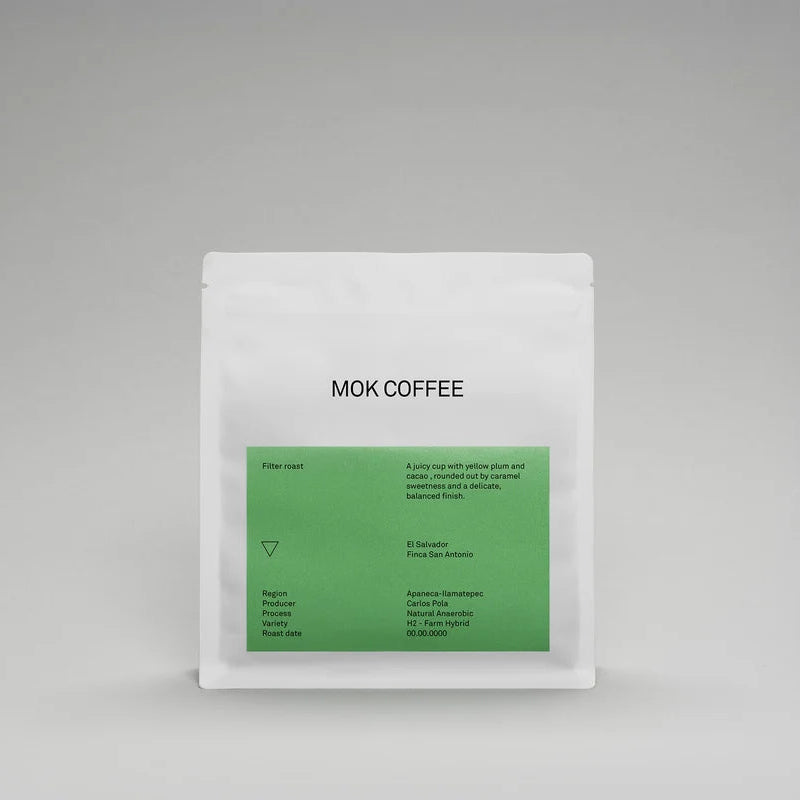

MOK COFFEE
MOK - Finca San Antonio {Filter} | El Salvador - Natural Anaerobic - H2-Farm Hybrid
MOK - Finca San Antonio {Filter} | El Salvador - Natural Anaerobic - H2-Farm Hybrid
 Origin: El Salvador
 Tasting Notes: Yellow Plum, Cacao, Caramel

 Process: Natural Anaerobic
 Varieties: H2 - Farm Hybrid
 Producer: Carlos Pola
 Region: Apaneca-Ilamatepec
 Recommended Brew: Filter
 Roast Date:
Couldn't load pickup availability
Mok Coffee Roasters is located in Brussels, Belgium
From MOK
At Finca San Antonio, Carlos Pola combines a family background in coffee with experience gained in the textile industry. Located near Juayúa in El Salvador’s Apaneca-Ilamatepec mountain range, the farm sits at 1,350 metres above sea level. Here, his work centres on quality, traceability and finding practical ways to grow coffee with fewer chemical inputs. Carlos purchased his first farm, Finca Las Brisas, in 1997, while still working in textiles. In 2012, he moved into coffee full time. He brought with him a close attention to detail, applying his knowledge of quality control and data management to both Las Brisas and San Antonio. An on-site laboratory supports processing trials, quality assessment and training for farm workers. He has also developed a traceability application that follows coffee from the day of harvest through to the export lot.
This lot is H2, one of the varieties Carlos and his family call their Farm Hybrids. Derived from Caturra and Timor, these plants have been selected over decades for their resistance to coffee leaf rust, quality and adaptation to local growing conditions. Each year, the family selects which plants to propagate, continuing that work of observation and refinement. After selective handpicking, the cherries are placed in sealed bags for three days of anaerobic fermentation. They are then sorted by flotation and spread on raised beds, where they dry whole for approximately 26 days. Frequent turning helps the cherries dry evenly. Once dried, the coffee rests on the farm before travelling to Cooperativa La Cuzcachapa in Chalchuapa for export preparation.
Alongside his own production, Carlos is committed to sharing knowledge and helping other farmers move into specialty coffee. His approach brings together practical experimentation, careful record keeping and an ongoing investment in the people working with him.