
SEY COFFEE
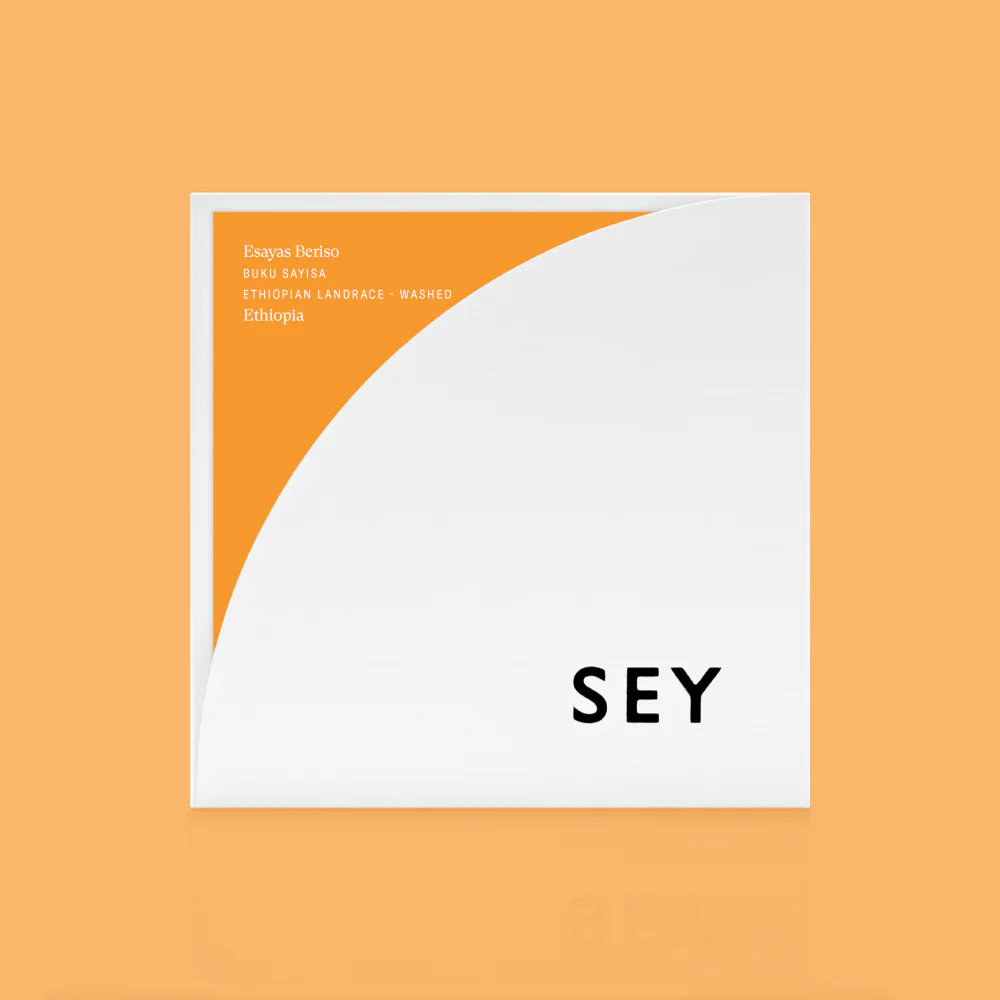
SEY - Esayas Beriso Buku Sayisa | Ethiopia - Washed - Ethiopia Landrace
SEY - Esayas Beriso Buku Sayisa | Ethiopia - Washed - Ethiopia Landrace
 Origin: Ethiopia
 Tasting Notes: Peach Rings, Raspberry, White Tea

 Process: Hand-picked at peak ripeness. Hand-sorted. De-pulped. Wet-fermented for up to 72 hours, then washed in channels and graded by density. Lower-density seeds were removed, retaining only the denser, higher-quality seeds for separation into higher-grade lots. Soaked for two hours post-fermentation. Dried in two-centimeter (0.8 inch) layers for ten days, then hand-sorted one final time.
 Varieties: Ethiopia Landrace
 Region: Hambela Wamena, Guji
 Elevation: 2350 masl
 Harvest: January 2026
 Recommended Brew: Filter
 Roast Date:
Couldn't load pickup availability
SEY COFFEE is located in Brooklyn, United States
From SEY
We have been working with Esayas Beriso for a few seasons now, and the quality continues to be exceptional. This lot is one of the few single-producer separations we get from the Guji Highlands, and we are excited to be working with it again this season. In the cup we find peach rings, raspberry, and white tea.
ABOUT ESAYAS BERISO
Buku Sayisa is one of the highest-elevation coffee-growing regions in Ethiopia, which creates optimal conditions for exceptional cup quality. Farm plots are scattered throughout the highlands, reaching upwards of 2,350 masl. Esayas Beriso began his career in a government office in Dimtu, during which time he and his brothers started a small operation collecting and selling farmers' coffee cherries to local wet mills. As the operation grew, Esayas planted his own trees. In 2009, he left his government position to become a full-time coffee business owner. Today, it is a family operation, with his wife Meskerem managing harvesting on their personal farm and buying cherry from neighboring farms.
ABOUT ETHIOPIAN LANDRACE
Ethiopia is widely acknowledged as where coffee originated, and its production continues to represent a significant part of the country’s economy. DNA testing has confirmed over 60 distinct varieties growing in Ethiopia, making it home to the most coffee biodiversity of any region in the world. Given the tradition of coffee production in Ethiopia and the political interworkings of the Ethiopian coffee trade, it is virtually impossible to get single variety coffee lots from Ethiopia. This is changing, albeit very slowly. Most Ethiopian coffees are blends of the many Ethiopian varieties, and referred to simply as 'Ethiopian Landrace'.