
1
/
of
1
NOMAD COFFEE
NOMAD - Juan Pinto {Filter} | Bolivia - Washed - Catuai

No reviews
Origin: Bolivia
Tasting Notes: Green Apple, Milk Chocolate, Chamomile
Process: Washed
Varieties: Catuai
Elevation: 1700 masl
Harvest: 2025
Recommended Brew: Filter
Roast Date:
Regular price
$48.00 CAD
Regular price
Sale price
$48.00 CAD
Unit price
/
per
Free Shipping Over $85 CAD (Canada) ❘ $100 USD (US) ▪︎ Free GTA Pickup Available
Couldn't load pickup availability
NOMAD Coffee Roasters is located in Barcelona, Spain
From NOMAD
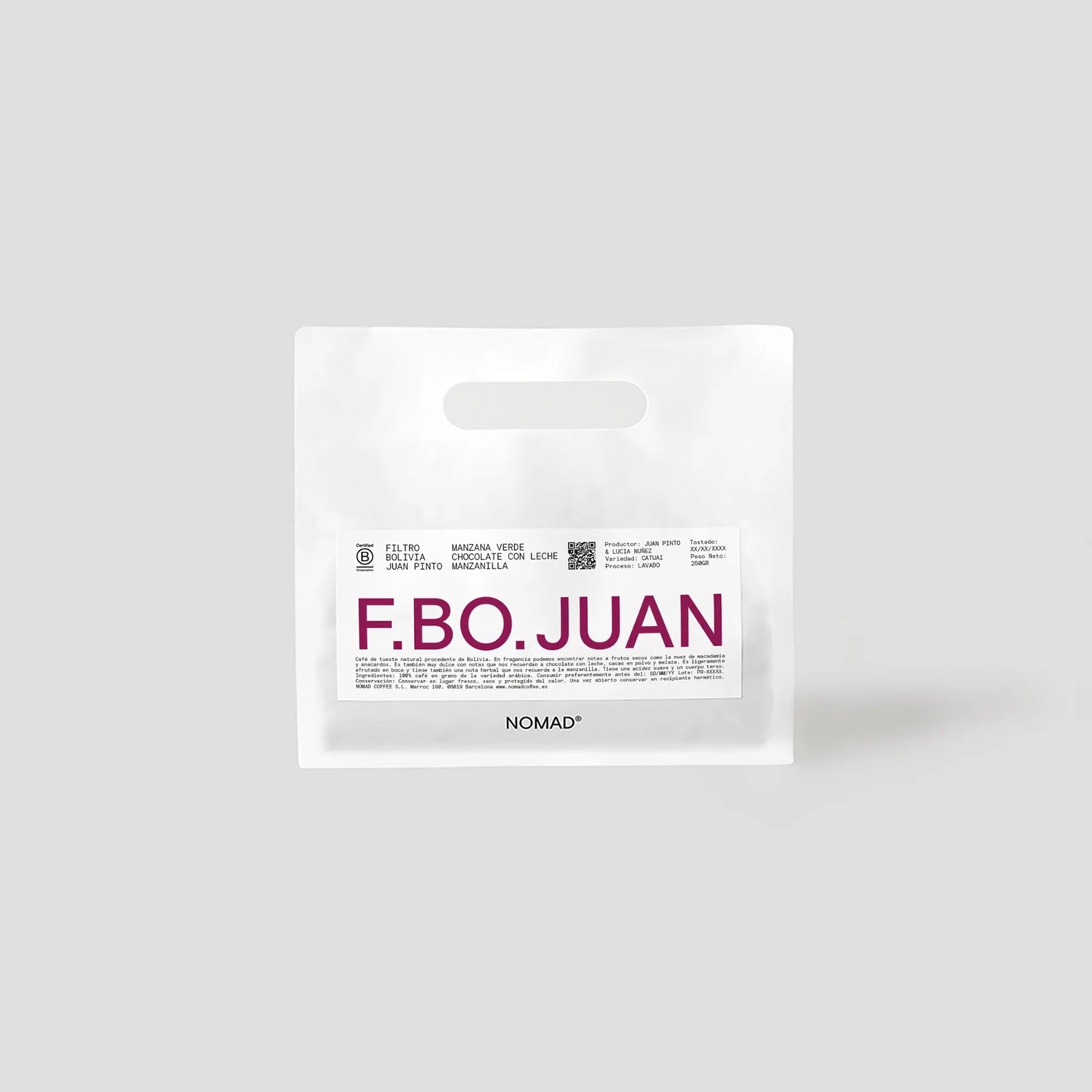
The aroma features notes of nuts such as macadamia and cashews. It is also very sweet, with notes reminiscent of milk chocolate, cocoa powder, and molasses. It is slightly fruity on the palate and also has a herbal note reminiscent of chamomile. It has a mild acidity and a smooth body.
In a region known for its cacao, Juan and Lucía are proving that Bolivia has much more to offer the world of specialty coffee. Finca Paraíso is the result of years of hard work, curiosity, and a philosophy of life that permeates everything: Vivir Bien, a concept inherited from the local indigenous peoples that speaks to thriving in harmony with the community and nature.
Juan came to coffee from the ground up. Raised in a coffee-growing family in Alto Beni, he spent over a decade working at Agricafe, where he trained in wet processing, laboratory work, quality control, roasting, and export. That experience—evaluating lots from smallholder farmers and refining his palate—is now the backbone of Finca Paraíso’s quality.
Lucía shares that same philosophy of continuous improvement. “Whenever we change something from the previous year, we’re eager to see how the coffee will turn out,” she explains. “Seeing our creativity reflected in the results is what motivates us.” Although each manages their own lot—Juan the Catuai, Lucía the Java—both insist that it has been a shared effort from day one.
The farm stands out for its meticulousness: perfectly organized seedbeds, spotless machinery, and storage with attention to detail. Juan never received formal training; he learned by observing, experimenting, and constantly asking himself how to improve. That same curiosity translates into the cup.
Process Harvesting is done manually, selecting only the cherries at their optimal ripeness, identified by a deep red color.
After harvesting, the coffee is pulped and placed in plastic bags to begin a controlled fermentation lasting between 24 and 48 hours. During this process, Juan constantly monitors the coffee using traditional methods honed through experience; when the mucilage begins to detach easily from the parchment, the fermentation is considered complete.
Subsequently, the coffee is Washed fresh water and transferred to raised drying beds, where it dries slowly for 15 to 20 days until it reaches approximately 12% moisture content.
Juan came to coffee from the ground up. Raised in a coffee-growing family in Alto Beni, he spent over a decade working at Agricafe, where he trained in wet processing, laboratory work, quality control, roasting, and export. That experience—evaluating lots from smallholder farmers and refining his palate—is now the backbone of Finca Paraíso’s quality.
Lucía shares that same philosophy of continuous improvement. “Whenever we change something from the previous year, we’re eager to see how the coffee will turn out,” she explains. “Seeing our creativity reflected in the results is what motivates us.” Although each manages their own lot—Juan the Catuai, Lucía the Java—both insist that it has been a shared effort from day one.
The farm stands out for its meticulousness: perfectly organized seedbeds, spotless machinery, and storage with attention to detail. Juan never received formal training; he learned by observing, experimenting, and constantly asking himself how to improve. That same curiosity translates into the cup.
Process Harvesting is done manually, selecting only the cherries at their optimal ripeness, identified by a deep red color.
After harvesting, the coffee is pulped and placed in plastic bags to begin a controlled fermentation lasting between 24 and 48 hours. During this process, Juan constantly monitors the coffee using traditional methods honed through experience; when the mucilage begins to detach easily from the parchment, the fermentation is considered complete.
Subsequently, the coffee is Washed fresh water and transferred to raised drying beds, where it dries slowly for 15 to 20 days until it reaches approximately 12% moisture content.
Share