
Mel Coffee Roasters
MEL - Guji G1 Rasta {Filter} | Ethiopia - Washed - Heirloom
MEL - Guji G1 Rasta {Filter} | Ethiopia - Washed - Heirloom
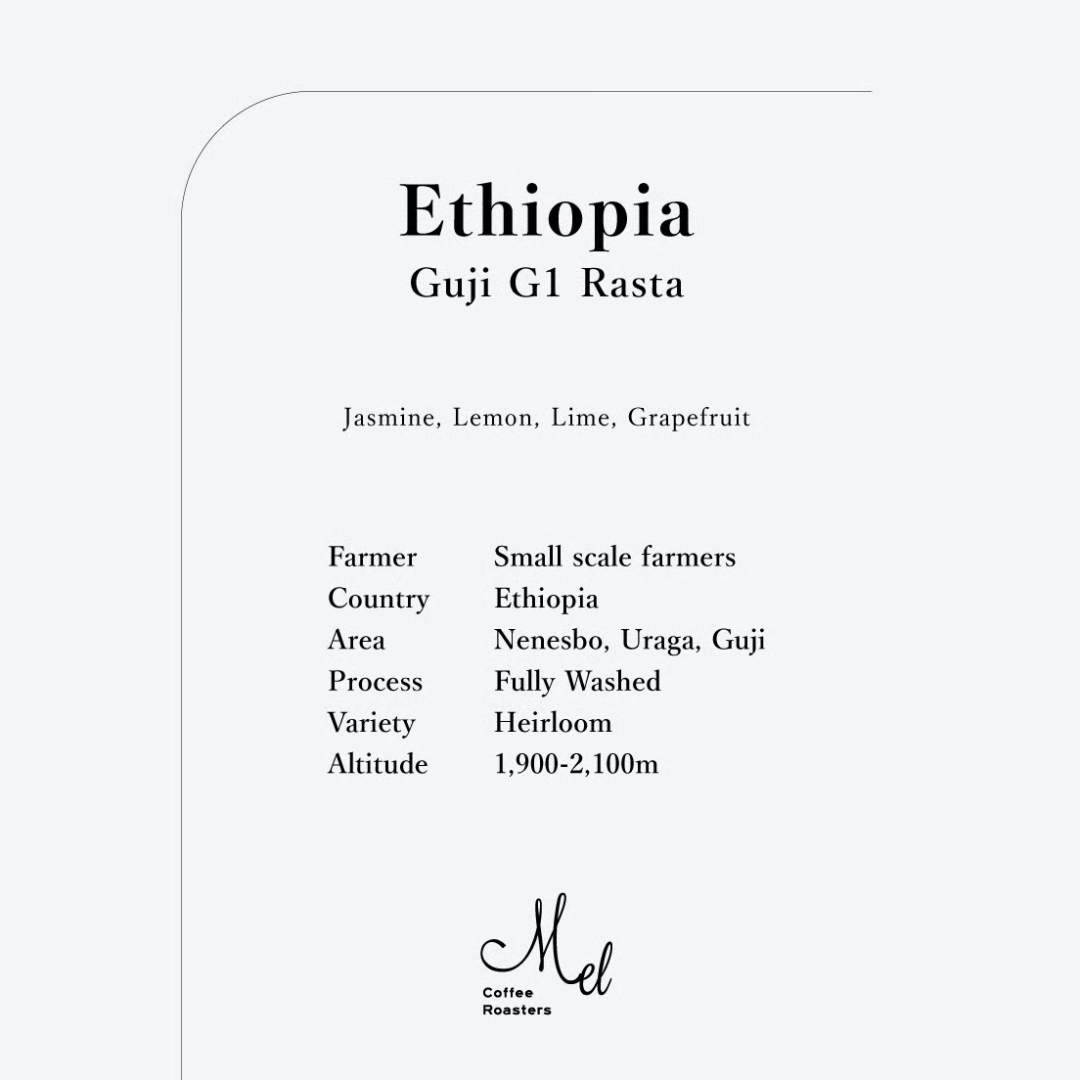
 Origin: Ethiopia
 Tasting Notes: Jasmine,, Lemon, Lime, Grapefruit

 Process: Washed
 Varieties: Heirloom
 Farm: Small Scale Farmers
 Region: Nenesbo, Uraga, Guji
 Elevation: 1900 - 2100 masl
 Roast Profile: Light
 Recommended Brew: Filter
 Roast Date:
Couldn't load pickup availability
Mel Coffee Roasters is located in Osaka, Japan
From MEL
During the hours of 11 am to 3 pm when the sunlight is strongest, the parchment is covered with plastic sheeting. This is to protect the parchment and prevent rapid drying. In this region, which is at a high altitude and located near the equator, too much sunlight can damage the cherries and parchment, resulting in a cloudy taste. Also, instead of the usual 8 days of drying, the beans are dried slowly over 12 to 15 days (slow drying), which equalizes the moisture content within the coffee, creating a complex yet clean flavor. It has been found that gradual drying significantly impacts the shelf life of green coffee beans in consuming countries. After drying, the hulled green beans are sorted by machine, then hand-picked to produce high-quality FW coffee. The method is simple, but human effort greatly influences the quality.
The Guji region, located in southern Ethiopia, is one of Ethiopia's leading coffee-producing areas, alongside Yirgachev. Surrounded by abundant nature, the coffee cherries, grown under conditions ideal for coffee cultivation (high altitude, fertile, well-drained soil, and significant diurnal temperature differences), produce a complex flavor with concentrated sweetness and acidity. Due to the high altitude and complex terrain, mechanical harvesting is not possible. Therefore, each bean is carefully harvested by hand.
Within the Guji region, the Uraga area is particularly high in altitude and has been a source of high-quality coffee, a region where BNT has continued its activities. They are committed to producing high-quality coffee at their wet processing plant in Nenesvo village.
The name "Rasta" was inspired by a conversation I had while staying in Awasa, a key point on the way from Addis Ababa, the capital of Ethiopia, to Guji, where I heard there was a "Rasta village" nearby. I named it "Guji-Rasta" as a tribute to the sacred country of Ethiopia and this wonderful flavor.