
HATCH COFFEE ROASTERS
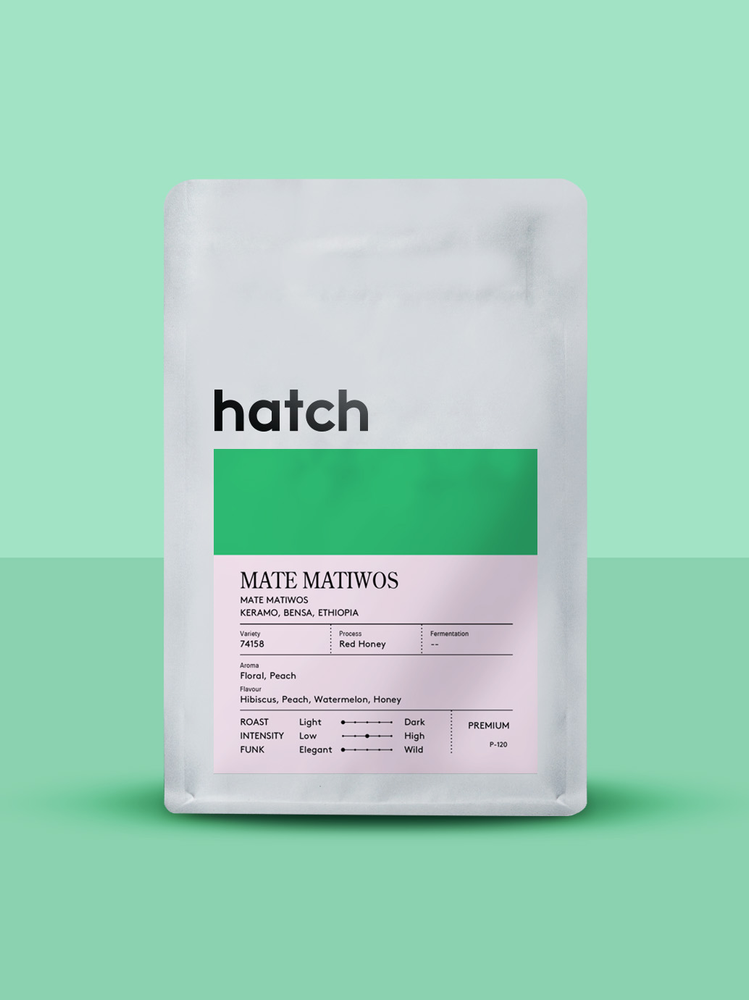
HATCH - Mate Matiwos | Ethiopia - Red Honey - 74158
HATCH - Mate Matiwos | Ethiopia - Red Honey - 74158
 Origin: Ethiopia
 Tasting Notes: Hibiscus, Peach, Watermelon, Honey

 Process: Red Honey
 Varieties: 74158
 Producer: Mate Matiwos
 Region: Sidama, Ethiopia
 Elevation: 2100 masl
 Harvest: 2025
 Recommended Brew: Filter
 Roast Date:
Couldn't load pickup availability
Hatch Coffee Roasters is located in Markham, Ontario, Canada
From HATCH
From Swift Coffee:
“2nd place 2024 Cup of Excellence competition. Mate Mateyos is a coffee producer the founders of Swift Coffee Sourcing have partnered with in various ways since the 2016-2017 coffee harvest. He is part of a special group of Single Farmers who originally brought their cherries to a washing station we exclusively supported, while each year brought more and more isolation of the lots until, going on a decade later, we offer this microlot from Mate’s Keramo area farm.”
The first stage after harvesting our Red Honey coffee beginswith a swift hand-sorting to confirm that only uniformly ripe,evenly colored cherries move forward. These cherries are thenimmersed in small floatation tanks, where lower-density fruitrises to the surface and is removed for lower-grade lots orlocal consumption. The heavier, high-density cherries—anindicator of superior quality—sink and are selected for thenext stage. Another round of hand sorting follows to ensureeven ripeness before pulping.
For honey processing, the manual disc pulper is preciselycalibrated to provide steady, gentle pulping that minimizesdamage to both parchment and seed while preserving as muchmucilage as possible. It’s enormously labor intensive at Mate’sfarm, because all this is done by hand and withoutmechanization.
After pulping, the parchment destined for honey processingundergoes a brief fermentation phase. The sticky, mucilage-richcoffee is then transferred to shaded drying beds with strongairflow, where it dries slowly and evenly beneath a canopy.This shaded approach extends the drying period by about four tofive days compared to sun drying but allows for better controlof moisture distribution and a balanced water activity level.Consistent, carefully timed turning and covering of theparchment are vital to achieving the uniformity that definespremium honey coffees.”